Documentation
Coverage & freshness
What Billy polls today, how fresh data is, and how to read “data as of.”
What “near real time” means
Legislatures publish updates on daily (sometimes intra-day) cycles. Billy’s commitment: changes are surfaced within about one hour of appearing in our sources. How quickly each legislature publishes its own updates varies, so the UI shows a per-jurisdiction timestamp — you always know exactly how fresh the data is.
Sources
- States & territories (API path): Open States (Plural) API — bills with versions, abstracts, sponsorships, actions, sources.
- Federal: congress.gov API for metadata; GovInfo BILLS XML preferred for structured text.
- Regulations: the Federal Register (hourly) and the Indiana Register — proposed and final rules with comment-period deadlines. See Regulations.
- Hearings & deadlines: congress.gov committee meetings (every four hours) and the Indiana General Assembly schedule, plus published session-deadline calendars. See Calendar.
- People & committees: Open States and the public congressional directory — members, contact info, and committee rosters, refreshed daily.
- Statutes: the published Indiana Code, refreshed as new editions land — powering the law-as-amended view and its verification.
- Documents: Billy fetches bill text in whatever formats a source publishes and reads from the best one available — structured XML first, then HTML, then PDF.
Active jurisdictions today
Billy is built to support every US jurisdiction — federal, all fifty states, DC, and the territories. In this early launch we actively monitor a smaller set, and we’re expanding it steadily. You can select any jurisdiction at onboarding or in Settings, and monitoring turns on as coverage grows.
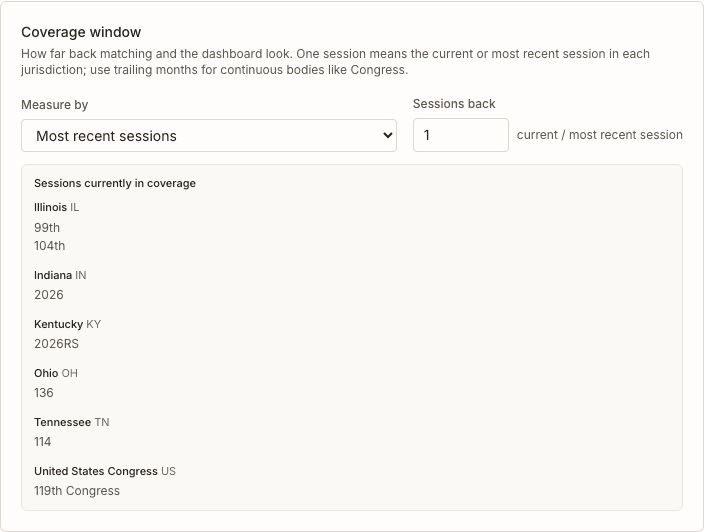
Jurisdictions we actively monitor today:
- Federal (US)
- Indiana (IN)
- Ohio (OH)
- Kentucky (KY)
- Tennessee (TN)
- Illinois (IL)
- Pennsylvania (PA)
“Data as of”
Feed and jurisdiction views show when Billy last successfully refreshed that jurisdiction. A timestamp from this morning is what you should expect while a legislature is in session; if it looks stale during a busy amendment week, that’s your cue to check status or contact support.
Normalization quality
Every document Billy processes gets a quality score reflecting how cleanly we could read it. When we’re less confident, you’ll see a caution badge — and the original PDF is always one click away. Federal and Indiana documents are our most battle-tested today; other states improve steadily as we tune them.
Billy also watches for chambers that change their document formatting mid-session — a surprisingly common occurrence — so we can catch it and adapt quickly.
Pipeline cadence
- Roughly hourly: check active jurisdictions for updated bills, then fetch the new text, compare it against the previous version, and notify you of what changed.
- Daily: digests, plus health checks that make sure data is staying fresh.
- Weekly: a full sweep to catch anything the hourly checks missed.
If a document hasn’t actually changed since we last saw it, Billy skips reprocessing it.
Sharing bills publicly
Anyone can open a public bill URL without signing in — see Public bill pages. Those pages only show public-record data and precomputed change summaries; they never spend your org’s AI budget.
Known coverage gaps
- Published-code verification — bill-vs-Indiana Code checks require a statute sync; other jurisdictions do not yet have an ingested code edition.
- Image-only PDFs — OCR fallback is not shipped; quality badges and the original PDF still apply when parsing is weak.
- Territories (Puerto Rico, Guam, USVI, AS, CNMI) and self-hosted Open States scrapers remain future coverage work.
- Published firm commentary on public bill pages is deferred — corrections stay workspace-private today.